

Aluminum 5754


For transport panels, formed housings, tread plate, and industrial fabrication, corrosion resistance is often the deciding requirement for Aluminum 5754. This Al-Mg alloy is valued because it combines good atmospheric and marine-environment resistance with reliable cold-forming behavior.
However, the alloy name alone does not define performance. Temper, thickness, surface condition, bending radius, weld procedure, and service temperature can all affect the delivered result. A specification that only states "5754 aluminum" leaves significant room for variation.
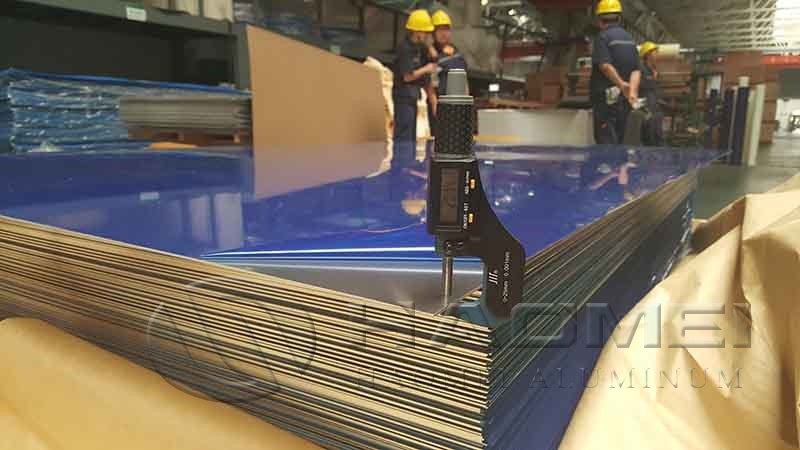
What EN AW-5754 Means and What to Specify
EN AW-5754 is a wrought aluminum-magnesium alloy covered by EN 573-3. Its registered chemical composition is controlled primarily by magnesium, which provides strength through solid-solution strengthening while retaining useful formability.
| Element | EN 573-3 composition requirement for EN AW-5754, % by mass |
|---|---|
| Magnesium, Mg | 2.6-3.6 |
| Manganese, Mn | 0.0-0.5 |
| Chromium, Cr | 0.0-0.3 |
| Iron, Fe | Maximum 0.4 |
| Silicon, Si | Maximum 0.4 |
| Copper, Cu | Maximum 0.1 |
| Zinc, Zn | Maximum 0.2 |
| Titanium, Ti | Maximum 0.15 |
The chemistry range explains why material from different qualified mills can have slightly different forming response, even when both conform to the same designation. For critical deep drawing or tight-radius bending, require the actual chemical analysis on an EN 10204 3.1 inspection certificate instead of relying on nominal composition.
Use Aluminum 5754 when moderate strength, weldability, and corrosion resistance are required in a non-heat-treatable alloy. It is commonly supplied in annealed and strain-hardened tempers, including O, H111, H22, H32, and H34. The correct temper should be selected from the fabrication route, not simply from a previous order.
Temper Selection Checklist
| Application condition | Practical temper direction | Specification control to add |
|---|---|---|
| Deep drawing, complex press forming | O or H111 | Define minimum elongation and bend-test requirement |
| General formed panels | H22 or H32 | State thickness tolerance and surface class |
| Higher dent resistance with moderate forming | H34, subject to bend validation | Confirm inside bend radius with production tooling |
| Welded structures | H111 or H32 are often evaluated | Qualify the weld procedure and inspect the heat-affected zone |
Mechanical-property values must be taken from the applicable thickness range and product standard. EN 485-2 provides mechanical-property requirements for sheet, strip, and plate products, while EN 515 defines temper designations. Do not compare tensile values from different thickness brackets as if they were directly interchangeable.
Protecting Corrosion Resistance During Forming and Welding
The major purchasing risk is rarely uniform corrosion on a clean, correctly fabricated surface. More frequent avoidable failures come from contamination, stagnant moisture, unsuitable fasteners, damaged coatings, or excessive local strain near bends and welds.
5754 has good resistance to normal atmospheric exposure and many marine conditions, but it is not immune to galvanic corrosion. When aluminum is coupled with more noble metals in the presence of an electrolyte, the aluminum may corrode preferentially. Isolate dissimilar metals with compatible nonconductive barriers, seal lap joints that retain water, and specify coated or suitable fasteners for the exposure environment.
For welding, this 5xxx-series alloy is generally weldable by common fusion processes. Yet welding changes the temper in the heat-affected zone. A strain-hardened product can lose some locally achieved strength adjacent to the weld, so structural calculations should use design data appropriate to the welded condition. Require a qualified welding procedure and define visual, dimensional, and, where needed, non-destructive inspection criteria.
For tank and trailer-related fabrication, the alloy grade must never be treated as proof of finished-equipment compliance. The carried medium, operating temperature, weld design, pressure requirements, and regional transport rules all matter. Where a transport application needs a dedicated flat-rolled material comparison, evaluate Tanker Plate requirements alongside the relevant vessel or road-tanker standard.
Corrosion-Control Actions Before Production
- Define the exposure: indoor dry service, road salt, coastal atmosphere, standing water, or chemical contact.
- Specify finish requirements: mill finish, protective film, anodizing suitability, paint pretreatment, or coated surface.
- Identify all joining metals and require isolation where galvanic conditions can occur.
- Set a realistic minimum bend radius by temper and thickness, then validate it on production samples.
- For welded assemblies, record filler metal, process, heat input limits, cleaning method, and post-weld inspection.
- Require traceability from each production batch to its 3.1 certificate.
Purchase Order Controls That Prevent Disputes
A useful purchase order identifies the exact standard, alloy, temper, dimensions, tolerances, surface condition, inspection documents, and packaging method. It should also define whether material will be laser cut, formed, welded, anodized, painted, or exposed outdoors.
| Purchase-order item | Why it matters | Recommended wording approach |
|---|---|---|
| Alloy and standard | Prevents a loosely defined substitute | "EN AW-5754 in accordance with EN 573-3" |
| Product standard | Establishes dimensional and mechanical rules | "Mechanical properties to EN 485-2, as applicable" |
| Temper | Controls strength and forming behavior | State O, H111, H22, H32, or other required temper |
| Dimensions and tolerances | Avoids processing loss | State thickness, width, length, flatness, and edge condition |
| Surface | Protects appearance and coating performance | Define surface class, oiling, film, and allowable defects |
| Certification | Verifies compliance | Request EN 10204 3.1 certificate with heat or batch traceability |
| Packaging | Limits transit damage and moisture staining | Require dry, protected, clearly labeled packaging |
Material sustainability documentation should be requested separately from alloy certification. An EN AW-5754 designation does not prove recycled content, product carbon footprint, or environmental performance. If those data are required for reporting, request a supplier declaration that states the calculation method, system boundary, reporting period, and applicable environmental product declaration or third-party verification.
| Incoming inspection check | Acceptance evidence |
|---|---|
| Alloy and temper | Label, certificate, and ordered designation match |
| Chemistry | Certificate values fall within EN 573-3 limits |
| Dimensions | Calibrated measurement against stated tolerances |
| Surface condition | Inspection under agreed lighting and acceptance standard |
| Forming suitability | Trial bend or approved first-article sample where required |
| Traceability | Batch identification retained through cutting and fabrication |
Original Source:https://www.aluminumtankerplate.com/a/aluminum-5754.html
Tags: Aluminum 5754 , EN AW-5754 , corrosion resistance , aluminum forming ,